Short Diploma in Process Safety Management Literacy
Short Diploma in Process Safety Management Literacy is a free program on ARPS, the Arab Platform for Professional Studies. A short diploma in management reading of process hazards, barrier evidence, change and response through fictional cases and simple calculations. A site can have no injuries while a critical trip test is overdue.
Important notice: Independent educational completion; no engineering authorization, professional licence or local compliance determination.
Assign hazard-decision ownership, performance, consultation and notification while preserving dissent.
From lesson 1, readable now without an account: Risk, barriers and indicators
When a manager asks, ‘No injuries were recorded this month; is the plant safe?’, first identify the kind of risk. A slip or cut is a direct injury to a person. A process safety catastrophe can begin when a system loses containment of a hazardous substance, control of energy, or control of a reaction, even if nobody was hurt in previous months. A favorable personal injury measure does not establish that the vessel, valve, shutdown function and operating response that prevent escalation will work. In this course, process safety management means organizing decisions that keep those barriers effective through operation, maintenance, change and emergency preparation. This lesson does not authorize barrier design or a determination that a particular site is safe. The US OSHA process safety standard, 29 CFR 1910.119, links such elements as process information, hazard analysis, mechanical integrity, management of change, investigation and audit. Its legal application is US-specific. We use its structure to learn how to question evidence, not to declare legal compliance elsewhere.
A free account saves your progress and takes you straight to lesson 1.
Program facts
Study fee
Free
subjects
7
lessons
28
Estimated time
84 hours
Content last reviewed
Access period
60 days
Study language
Arabic and English
About the program
A site can have no injuries while a critical trip test is overdue. Learn to separate injury outcomes from barrier evidence, then review deviations, change, equipment integrity, investigation, emergencies, indicators and audit, then everyday work interfaces and a capstone assurance dossier. Cases and numbers are fictional. Real decisions belong to qualified site specialists and authorized owners. Completion is educational; it grants no licence or local compliance determination.
Practical relevance
Desk worksheets classify gaps, reconcile records and calculate indicators. Real facility use requires site data, specialists, procedures and authority.
Why this program
The subjects ask which scenario, barrier, test result and decision owner a report supports, making review specific and bounded.
Career relevance
For operations, maintenance and quality supervisors and team managers: read records and escalate to specialists, with no employment or licensing promise.
Career paths this program serves
This program is a step on the paths of the following occupations. Open a path to see its other programs in study order.
Distinguish major-accident exposure from personal injury measures and link scenarios to barriers.
Assign decision, consultation and reporting roles when protective evidence is missing.
Screen process information and deviation/consequence/safeguard worksheets before accepting recommendations.
Review temporary and permanent change and evidence for equipment and operator readiness before startup.
Build an event timeline, test corrective-action effectiveness and plan a response exercise.
Show all (8)
Calculate indicators with sound denominators and draft a bounded audit finding and management decision.
Control everyday work interfaces: coordinate simultaneous work, trace spare-part suitability, hand over interrupted shifts and plan shared-utility outages.
Build a process safety assurance dossier that ties each conclusion to its evidence, designs an acceptance test, sequences dependencies and resources and revises the decision after new evidence.
Learning outcomes (28)
Distinguish a personal injury measure from process barrier evidence and write a specific escalation question when proof is missing.
Assign hazard-decision ownership, performance, consultation and notification while preserving dissent.
Design a reporting route that reaches an independent owner and returns traceable feedback without overreading report volume.
Compare resource requests using barrier function, evidence and interim authority, with a review criterion.
Register version gaps in substance, process and equipment information and hold only conclusions that depend on them.
Build a deviation, cause, consequence and safeguard worksheet with bounded arithmetic and a closable recommendation.
Map prevention and mitigation functions and detect shared dependencies before claiming independence.
Classify a hazard-review action as open, implemented pending verification or closed on functional evidence.
Separate alarm from trip thresholds and test whether the shift can apply the current response.
Distinguish like-for-like replacement from change and set impact and pre-startup checks.
Read an equipment inspection exception and reconcile measurement location and acceptance limit before trend or deferral judgment.
Connect contractor permit and isolation boundaries to functional test and pre-startup review.
Build a timeline separating event, detection, testimony and hypothesis while testing an alternative explanation.
Link a corrective action to a failure mechanism and test its effectiveness after implementation.
Design emergency escalation and notification exercises while reserving location decisions for current evidence and authority.
Reconcile worker and contractor evidence and return findings as role-specific instructions with a comprehension check.
Calculate outcome and barrier indicators with explicit denominators and explain the limits of zeros and rates.
Select a risk-relevant audit sample and write a bounded finding with a field-checkable closure criterion.
Integrate barrier, audit and investigation trends into an owned management decision with output and remeasurement date.
Write a conditional restart record aligning change, barrier, operator and emergency evidence under authorized escalation.
Map simultaneous-work relationships and identify the conflict, decision owner and handover condition between two teams.
Trace a spare part from request to issue, separating physical arrival from evidence-bounded suitability for its intended use.
Preserve the handover point during interruption and check the receiver’s understanding of current state and task-resumption conditions.
Build a shared-service consumer matrix and define entry conditions for the outage and restoration of dependent functions.
Build an evidence index, timeline and decision page that distinguish facts, interpretation and inference boundaries.
Design a paper verification specification distinguishing acceptance, noncompliance and inability to judge while preserving bounded results.
Calculate dossier completion from dependencies and resources, compare two options and update affected successors.
Present an argument, receive an evidenced objection, update the affected link and dependants, and plan mechanism-focused follow-up.
Who it is for
Operations, maintenance and quality supervisors who read alarm and inspection reports and need to distinguish verified performance from an open request.
Team managers who allocate resources, review change or seek an operating decision from its authorized owner instead of drawing engineering conclusions from a dashboard.
Learners seeking an applied foundation in process safety management literacy, ready to read Arabic or English case material and use basic percentages.
Prerequisites
You should be comfortable reading an ordinary work instruction and a dated log, and calculating a simple ratio such as 30 out of 40. The course defines trip, alarm and barrier when they first appear and uses desk cases that require no plant visit or equipment operation. Advanced engineering knowledge is unnecessary, but respecting specialist judgment and site decision rights is central to every exercise.
What it does not offer
This is not a formal engineering hazard study or hazardous-material field response qualification.
It does not establish a site's legal compliance in any country or grant an external professional credential.
Distinguish process safety from injury statistics through a loss-of-containment scenario, barrier function and evidence of effectiveness. Identify the operating decision owner, implementer and shift representative. Design reporting with a case ID, triage, feedback and an independent escalation route. Separate test funding from a passing result and keep competing hazards visible. Missing critical evidence requires escalation to specialists and authority with a review date.
4 lessons · 9.5 hours
Risk, barriers and indicators2 hours
Accountability and worker participation in hazard decisions2 hours
Process safety policy and protected reporting2 hours
Reading leadership signals and allocating resources2 hours
Subject 2
Process information and hazard analysis
Before analyzing a deviation, check the version of the chemical, technology and equipment information on which a conclusion depends. A team can explore a fictional overflow consequence while holding credit for a vent or trip whose records conflict with field state. Write a clear chain: defined deviation, plausible cause, consequence, prevention or mitigation function, then evidence question. Do not reverse cause and effect, or call alarm and shutdown independent if they share a sensor or power. A fill-time calculation shows why response matters, but is no guaranteed safe window without actual limits and measurement. A good recommendation has an owner, due date and closure test. A purchase order or published instruction is implementation progress, not a passing function test or proven shift understanding. Document why a technical recommendation changes and verify its alternative before closure.
4 lessons · 9.5 hours
Process information before a hazard review2 hours
From deviation to consequence and safeguard2 hours
Barrier maps and shared dependencies2 hours
Managing and closing hazard-review recommendations2 hours
Subject 3
Operations, change and integrity
An alarm threshold calls for its documented response; a higher trip is not automatic permission to wait. Test operator performance in a scenario matching the display and shift, not by attendance signature alone. When seal material, alarm setting or a temporary arrangement changes, separate the request and impact review from installed-state, function and training verification before startup. Give temporary changes expiry and a restoration owner; quiet operation does not make them permanent. For equipment integrity, distinguish an overdue test from a confirmed defect, and do not calculate corrosion from two different measurement points. Contractor task completion is not process readiness: reconcile permit, isolation, valve identity and result, diagram and shift communication. A real operating decision remains with competent site specialists and the authorized owner.
4 lessons · 9.5 hours
Operating limits and response to deviations2 hours
Managing change before restart2 hours
Mechanical integrity and inspection deferrals2 hours
Contractor interfaces, work permits and pre-startup review2 hours
Subject 4
Learning from events and response
In an investigation, record report, detection and response times from their sources; detection time is not automatically event onset. Separate worker testimony, records and hypotheses, and test whether documents, interfaces or handover enabled the final act. Tie corrective action to a specific failure mechanism, then distinguish implementation from later effectiveness: full training attendance may still fail a response simulation. In emergencies, activate site-plan notification and initial protection while leaving location-specific action to incident command and current substance/weather evidence. A table-top exercise should expose contact gaps and produce a repair and retest. Include affected workers and contractors when reconciling records, then return role-specific instructions whose understanding can be tested without publishing unproved blame.
4 lessons · 9.5 hours
Facts and latent conditions in investigation2 hours
Corrective actions and effectiveness checks2 hours
Emergency response decisions and exercises2 hours
Worker participation and closing the learning loop2 hours
Subject 5
Indicators, audit and integrated decision
Start an indicator with a hazard scenario and barrier function, then define numerator, denominator and period. On-time testing differs from all completed work, and zero releases do not prove overdue barrier condition. In audit, trace a specific criterion from document to record, field state and worker explanation, stating the sample boundary instead of generalizing it. In management review, bring deferrals, investigations, audits and change together, giving each gap an owner, decision, date and return test rather than ending with ‘discussed’. For restart, match the time and identity of change, trip, procedure, shift competence and emergency response evidence. Signatures in one axis cannot offset a critical gap in another. When new evidence arrives, recheck the affected axis before the authorized owner's decision.
4 lessons · 9.5 hours
Process safety indicators and denominators2 hours
Audit evidence: document and field practice2 hours
Management review of barrier trends2 hours
An integrated restart decision and its limits2 hours
Subject 6
Controlling everyday work interfaces
Review work interactions, spare-part traceability, shift handover and shared-service outages. Produce records identifying state, evidence, ownership and the next-step condition.
4 lessons · 16 hours
Coordinating simultaneous work and permit boundaries3 hours
Receiving spare parts and tracing suitability3 hours
Shift handover when work is interrupted3 hours
Planning the loss of shared utilities3 hours
Subject 7
Process safety assurance dossier capstone
Build an evidence dossier, verification protocol and resource schedule, then defend and revise the argument after an evidenced objection. The desk-based capstone includes solutions and follow-up criteria.
4 lessons · 21.5 hours
Capstone dossier: case boundaries and evidence provenance4.5 hours
Capstone verification: design a function acceptance test4.5 hours
Capstone implementation: sequence dependencies and resources4.5 hours
Capstone defence: revise a decision after new evidence4.5 hours
Subjects unlock in sequence as you progress.
Strengths
Seven subjects link leadership questions to barrier state, change, investigation, management review, everyday work interfaces and an assurance dossier.
Sixty output-bearing exercises have data, solutions and limits, with learning checks separate from subject assessments.
Arab-city cases are explicitly fictional and do not transpose US law to other jurisdictions.
Reproducible indicator arithmetic explains denominators and uncertainty.
Evidence basis
The US process safety standard supports descriptions of its elements within its scope; HSE, IChemE and CSB materials inform leadership, indicators, change and investigation. Source version, location and limits are recorded. Citation does not imply publisher endorsement. Case data are original and fictional.
Reference organizations
Occupational Safety and Health Administration
Health and Safety Executive
Institution of Chemical Engineers
U.S. Chemical Safety and Hazard Investigation Board
Frameworks used
IChemE Process Safety Leadership Framework — public online framework checked 2026-10-23
HSE process safety indicator method — HSG254, 2006
Methodology
Lessons teach a specific management output through a worked case and two exercises. Author self-review separates stems from keys; no independent human review or learner trial is claimed.
How the route works
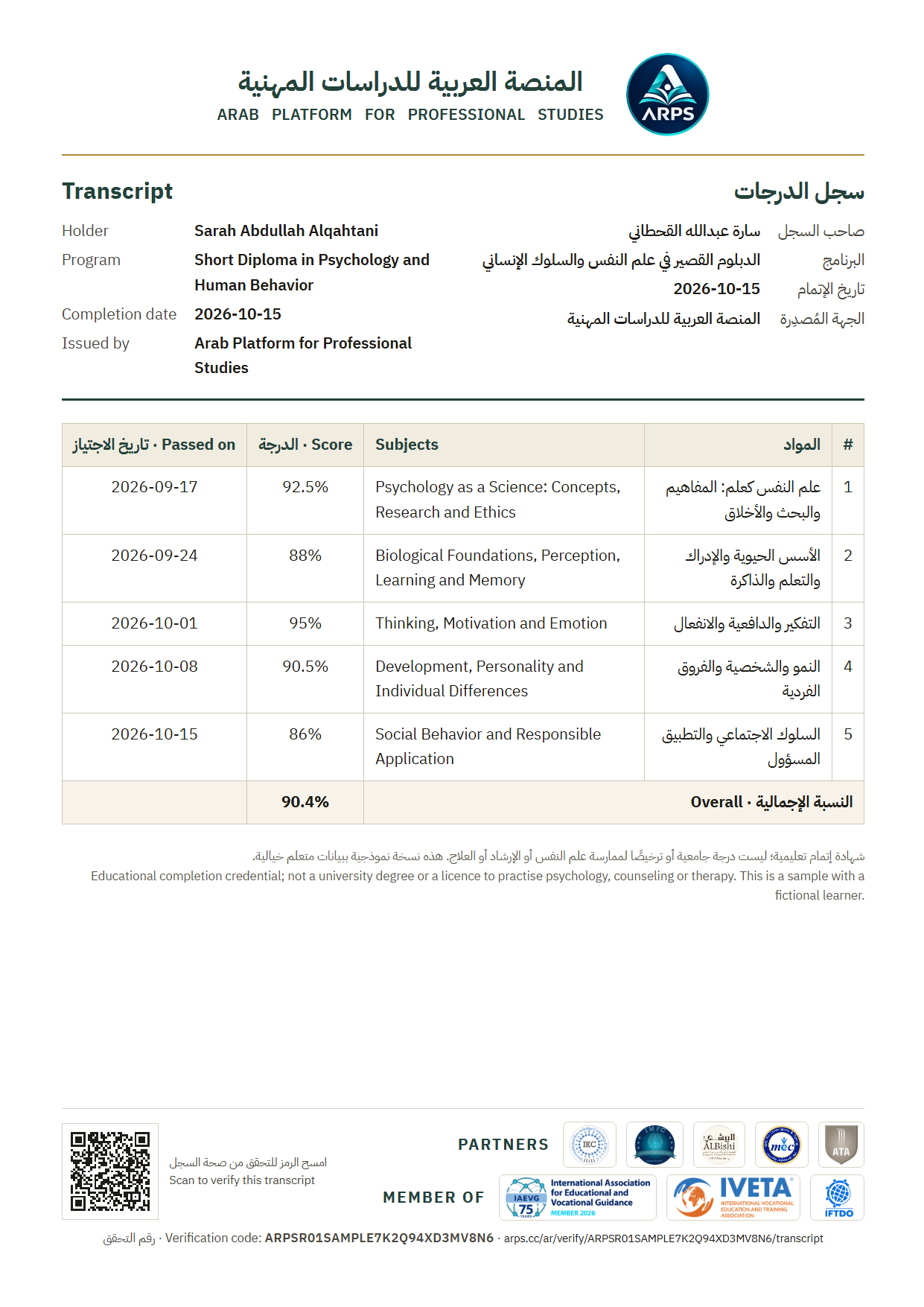
Short Diplomas are relatively comprehensive learning pathways that cover a major subject through five connected learning subjects and structured assessments, with a diploma transcript available with the credential.
Self-paced sequential study. Content unlocks progressively and each subject combines reading, examples, exercises, knowledge checks, and assessment.
Build integrated knowledge in a major subject.
Study through five clear, connected learning subjects.
Complete a defined assessment for each subject.
Receive a diploma transcript showing subjects and results when the credential is issued.
Assessment
Each Short Diploma contains five subjects, each with an approved assessment. A sixth final exam is not required when the five assessments adequately cover the learning outcomes.
Assessment attempts: 2 per assessment, 7 days apart
The pass mark is announced before the program is published.
Certificate
Successful completion makes the learner eligible for the Short Diploma certificate and Diploma Transcript under the credential policy.
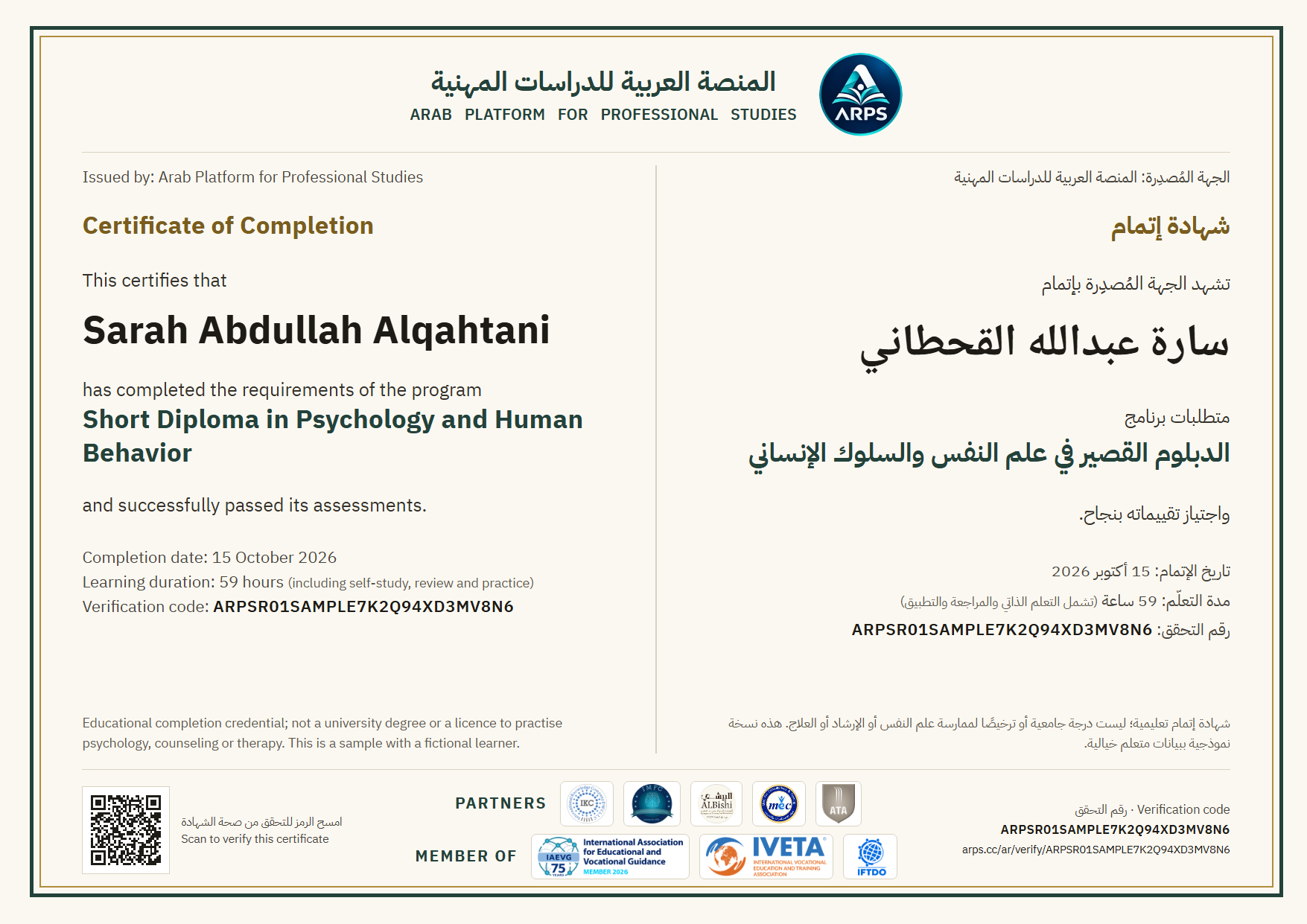
A sample from a real program in this track: Short Diploma in Psychology and Human Behavior. The learner, scores and dates are fictional; opens in a new window.
Disclaimer: Educational completion, not a university degree, engineering authorization or professional licence.
Program questions
Does this diploma authorize engineering practice or provide a licence?
No. It teaches management reading, evidence questions and escalation, not specialist or local authority decisions.
Do OSHA requirements apply in every country?
No. The US text is described within its legal scope and used to teach management logic; local law and site rules must be checked separately.
Do I need a plant or technical software for the exercises?
No. Fictional cases supply the needed data; real decisions require site specialists and authority.
Do I need facility design experience?
No. Cases supply operating facts and teach management questions and escalation; no engineering design calculation is required.
Are the city cases actual incidents or plants?
No. Cities and numbers identify fictional training cases. Public sources support the method without attributing an incident to a real facility.
Show all (7)
Is Short Diploma in Process Safety Management Literacy free, and do I get a certificate?
Yes. Short Diploma in Process Safety Management Literacy is free on ARPS: every lesson, exercise and assessment is free, the first subject is open to read without an account, and the program is available in Arabic and English. Issuing a certificate is optional and has a published fee; it is a training completion certificate showing you passed the program's assessments, recognised by most private-sector organisations in the Gulf states and most Arab countries, and it strengthens your CV; confirming that a specific organisation accepts it remains your responsibility.
What other names is Short Diploma in Process Safety Management Literacy known by?
The subject of this program is also known as: process safety management, PSM, process safety, major accident hazards. Learners usually find it by searching for: process safety management course, process safety management course online, process safety management course free, process safety fundamentals, HAZOP basics.
A five subject short diploma connecting risk, preparedness, coordination, communication and recovery through applied cases. It concludes with a supply-distribution continuity capstone.
Learn to frame, analyze and evaluate risks, then prepare controls and readiness for a bounded service. Fictional data lead to a risk register, continuity card, exercise and documented corrective action within a specialist role.
This short diploma connects market-research design with consumer-behavior interpretation and evidence-bounded decisions. Six subjects progress from the research question through sampling, measurement, analysis, choice journeys, testing, and recommendation, ending with an applied market-research capstone.
6 subjects
24 lessons
62.5 hours
Free
Next step: a professional certification or a mini-master
Programs in the same domain that prepare you for an international certification exam or form a professional mini-master, also free.